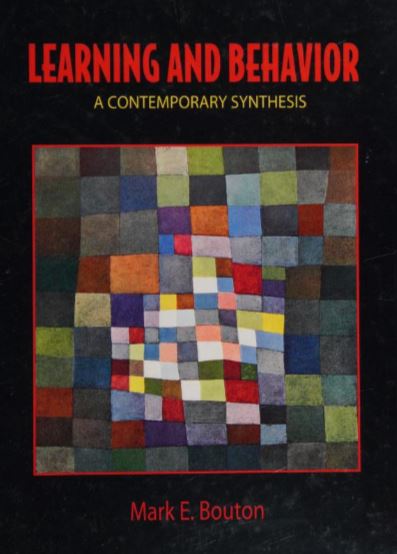
Learning and Behavior: A Contemporary Synthesis

By (author)Mark E. Bouton

Here are key conceptual tags and descriptions based on the topics covered in Mark E. Bouton’s Learning and Behavior: A Contemporary Synthesis:
  • Classical Conditioning (Pavlovian Learning): A foundational learning process where a neutral stimulus becomes associated with a biologically significant stimulus, triggering an involuntary or automatic response.
  • Operant Conditioning (Instrumental Learning): A method of learning where behavior is modified through consequences—reinforcement strengthens a response, while punishment weakens it.
  • Extinction and Context: The process of reducing a learned response by removing the reinforcer or unconditioned stimulus. Bouton’s research highlights that extinction is context-dependent and represents new learning rather than unlearning.
  • Reinforcement Schedules: Rules that determine how and when a behavior will be rewarded (e.g., fixed/variable ratio or interval schedules), influencing the rate and persistence of the response.
  • Stimulus Control and Discrimination: The capacity of specific environmental cues to trigger or inhibit a learned behavior based on prior experience with those stimuli.
  • Aversive Control: Behavioral principles involving unpleasant stimuli, including punishment (decreasing behavior) and negative reinforcement (escape or avoidance learning).
  • Habit vs. Goal-Directed Behavior: The distinction between actions driven by explicit, expected outcomes (goal-directed) versus automatic, stimulus-driven routines formed through extensive practice (habits).
  • Associative Learning Theory: The theoretical framework explaining how organisms form mental connections between events, stimuli, and behaviors to predict future outcomes.
Here are key conceptual tags and descriptions based on the topics covered in Mark E. Bouton’s Learning and Behavior: A Contemporary Synthesis:
  • Classical Conditioning (Pavlovian Learning): A foundational learning process where a neutral stimulus becomes associated with a biologically significant stimulus, triggering an involuntary or automatic response.
  • Operant Conditioning (Instrumental Learning): A method of learning where behavior is modified through consequences—reinforcement strengthens a response, while punishment weakens it.
  • Extinction and Context: The process of reducing a learned response by removing the reinforcer or unconditioned stimulus. Bouton’s research highlights that extinction is context-dependent and represents new learning rather than unlearning.
  • Reinforcement Schedules: Rules that determine how and when a behavior will be rewarded (e.g., fixed/variable ratio or interval schedules), influencing the rate and persistence of the response.
  • Stimulus Control and Discrimination: The capacity of specific environmental cues to trigger or inhibit a learned behavior based on prior experience with those stimuli.
  • Aversive Control: Behavioral principles involving unpleasant stimuli, including punishment (decreasing behavior) and negative reinforcement (escape or avoidance learning).
  • Habit vs. Goal-Directed Behavior: The distinction between actions driven by explicit, expected outcomes (goal-directed) versus automatic, stimulus-driven routines formed through extensive practice (habits).
  • Associative Learning Theory: The theoretical framework explaining how organisms form mental connections between events, stimuli, and behaviors to predict future outcomes.


Customer Reviews

There are no reviews yet.

Be the first to review “Learning and Behavior: A Contemporary Synthesis”

Your email address will not be published. Required fields are marked *