| BOOK NAME | |
|---|---|
| BOOK AUTHOR |
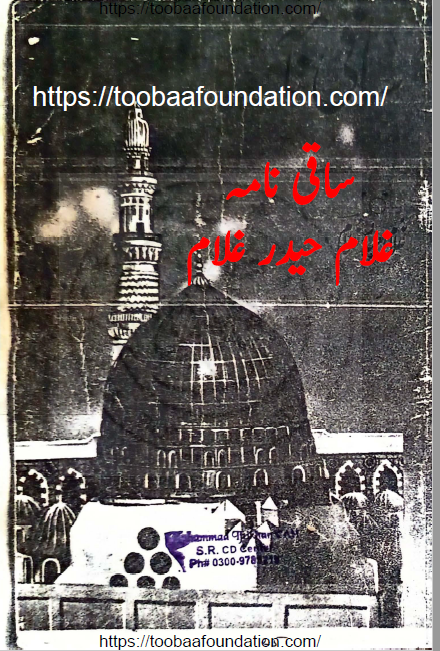


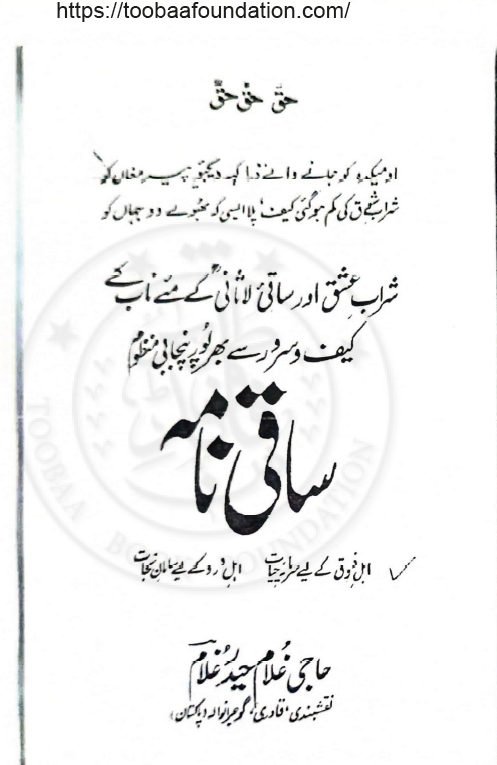
Saqi Nama/ساقی نامہ
Author : Toobaa Book Foundation
“Saaqi Nama” is a unique and spiritually enriching collection of Islamic spiritual poetry and Naatiya poetry book by Ghulam Haider Ghulam Naqshbandi Qadri Zaid Majdahu. This book delves into the depths of divine love poetry, devotion to the Prophet Muhammad (PBUH), and Sufi mysticism and devotion. Each verse beautifully reflects the harmony of nature and mystical poetry on Prophet Muhammad (PBUH), stirring emotions of spiritual longing within the reader.
The poetry in “Saaqi Nama” is imbued with the essence of Islamic Sufi poetry and mystical insight. The words resonate with the eternal quest for spiritual connection, inspiring the reader with a profound sense of Sufi wisdom and enlightenment.
Haji Ghulam Haider Sahib’s (Haji Ghulam Haider Sahib) heartfelt poetry mirrors the Sufi traditions of Punjab and the spiritual heritage of his esteemed predecessors, particularly his deep-rooted connection with Syed Jamaat Ali Shah Sani Alipuri (Syed Jamaat Ali Shah Sani Alipuri), a revered figure in the Naqshbandi Sufi order.
Alipur Saydan – A Hub of Spiritual Legacy
Alipur Saydan, located in Sialkot, Pakistan, is a historically significant and sacred town. It has been home to great spiritual figures such as Syed Hafiz Jamaat Ali Shah Sahib (Syed Hafiz Jamaat Ali Shah Sahib) and Syed Jamaat Ali Shah Sani (Syed Jamaat Ali Shah Sani), whose presence illuminated the region with the light of faith and divine blessings.
Chorah Sharif – The Spiritual Center
Chorah Sharif, in Gujranwala, holds a central place in the realm of Sufism and spiritual enlightenment. It has nurtured countless seekers of truth under the guidance of saints like Baba Ji Faqir Muhammad Chorahi (Baba Ji Faqir Muhammad Chorahi) and Hazrat Aman Sahib (Hazrat Aman Sahib), spreading divine wisdom far and wide.
“Saaqi Nama” – A Mirror of Love and Devotion
Each verse in “Saaqi Nama” radiates with the fervor of divine love and devotion to the Prophet Muhammad (PBUH). The poetry carries an eternal glow of Islamic heritage of Sialkot, touching the hearts of seekers on the path of spirituality.
Haji Ghulam Haider Sahib’s poetic contribution is a valuable addition to Sufi literature in Urdu. May Allah bless his passion and grant this work the power to guide seekers of truth for generations to come.
This book is available for free download and online reading at Toobaa Book Foundation. For more details and to get your free copy, visit the link below:
Customer Reviews
There are no reviews yet.
Related products
-

Al-Qaul al-Jali Fi Hayat-un-Nabi | القول الجلی فی حیات النبی
القول الجلی فی حیات النبی ایک مستند اور عقیدت آمیز سیرتی تصنیف ہے جس میں حضور نبی اکرم ﷺ کی حیاتِ طیبہ کے مختلف پہلوؤں کو نہایت سادہ، مدلل اور مؤثر انداز میں بیان کیا گیا ہے۔ حضرت مولانا قاضی شمس الدین نے اس کتاب میں سیرتِ رسول ﷺ کو قرآن و سنت کی روشنی میں پیش کیا ہے، جو عام قارئین کے ساتھ ساتھ طلبۂ علومِ دینیہ کے لیے بھی مفید ہے۔
-

Khud Se Khuda Tak PDF | خود سے خدا تک
Khud Se Khuda Tak | خود سے خدا تک ناصر افتخار کی ایک روحانی اور فکری کتاب ہے جس میں انسان کی داخلی اصلاح، خود شناسی، روحانی بیداری اور اللہ تعالیٰ سے تعلق کو خوبصورت انداز میں بیان کیا گیا ہے۔
یہ کتاب قاری کو نفس کی اصلاح، مثبت سوچ، اخلاقی تربیت اور روحانی سکون کی طرف راغب کرتی ہے۔ سادہ اور مؤثر اندازِ تحریر کی وجہ سے یہ کتاب اسلامی روحانیت، خودی کی پہچان اور ذاتی بہتری میں دلچسپی رکھنے والے قارئین کے لیے نہایت مفید ہے۔
-

TOOBAA RESEARCH BLOG ENGLISH BOOKS
☆THE NOBLE QURAN
(ENGLISH TRANSLATION)
☆URDU TRANSLATION OF QURAN
KNOWN AS : MOUZUH E FURQAN
BY: HAZRAT SHEIKH UL HIND
ALLAMA MAHMOOD HASSAN DEOBANDI
☆URDU TAFSEER (COMMANTERY)
KNOWN AS: TAFSEER E USMANI
BY: SHEIKH UL ISLAM ALLAMA SHABBIR AHMED USMANI
☆ENGLISH TRANSLATION BY:
MUHAMMAD ASHFAQ AHMED
Presented By : TOOBAA RESEARCH LIBRARY
……………………..
The Abridged Shamail e Tirmizi
Author: Muḥammad ibn Īsá Tirmidhī
With Notes from Sheikh ul Hadeez Moulana Mohamad Zakariya
And Mufti Ahmed E. Bemat
Translated by: Murtaz Hussain F. Quraishi
Presented By : TOOBAA RESEARCH LIBRARY
………………………………..
THE GREATEST BENEFACTOR OF MANKIND OF HUMAN RIGHTS
☆Muhsin e Insaniyat S.A.W aur Insani Haqooq
Khutbaa Hajaa tul Widaa se istshhad(URDU)
WRITTEN BY: DR Hafiz MUHAMMAD SANI (THANI)
preface : Dr Allama Muhadizz Abdul Haleem Chishti sb
Translated by: ZAHARA BAINTNER
GERMAN NAME: SABINE BAINTNER
Presented by: TOOBAA RESEARCH LIBRARY
………………………….
BY : KAUSAR NIAZI
PRESENTED BY : TOOBAA RESEARCH LIBRARY
………………………….
(SIRAT- US – SIDDIQ)
THE FIRST CALIPH OF ISLAM
BY: Nawab Sadr Yar Jung Bahadur
Maulvi Muhammad Habibur Rahman Khan Sharwani
Translated by: SYED MOINUL HAQ
RESENTED BY: TOOBAA RESEARCH LIBRARY
………………………..
(THE SECOND CALIPH OF ISLAM)
AL FAROOQ – VOL 2
AUTHOR: ALLAMA SHIBI NOUMANI
TRANSLATED BY: MUHAMMAD SALEEM
PRESENTED BY: TOOBAA RESEARCH LIBRARY
………………………..
IMAM ABU HANIFAH LIFE AND WORK
(SEERAT U NOUMAN)
AUTHOR: ALLAMA SHIBLI NOUMANI
TRANSLATED BY: M. HADI HUSSAIN
PRESENTED BY: TOOBAA RESEARCH LIBRARY
……………………
THE POLITICAL THOUGHT OF IBN TAYMIYAH
BY : PROF QAMARUDDIN KHAN
PRESENTED BY : TOOBAA RESEARCH LIBRARY
…………………………………..
(TAWEEL UL AHADEEZ)
BY: SHAH WALIULLAH
RENDERED INTO ENGLISH
BY: PROF G. N. JALBANI
PRESENTED BY : TOOBAA RESEARCH LIBRARY
…………………………
BY: IMAM SHAH WALIULLAH DEHLVI
RENDERED INTO ENGLISH
BY: PROF G. N. JALBANI
PRESENTED BY : TOOBAA RESEARCH BLOG
…………………………………………
A SAINT-SCHOLAR OF MUSLIM INDIA
AUTHOR: A. D. MUZTAR
Presented by: TOOBAA RESEACRH LIBRARY
…………………………….
Author: DR. A. J. HALEPOTA
(Professor of comparative religion and Islamic culture, University of Sind. & Ex. Chairman Council of Islamic ideology Pakistan )
Presented by: TOOBAA RESEACRH LIBRARY
……………….
RESEARCH PAPER FOR: PhD
RESEARCH by: TASADDUQ HUSAIN
ALIGARH MUSLIM UNIVERSTY INDIA
REPRESENTED BY: TOOBAA RESEARCH LIBRARY
…………………..
ENGLISH TRANSLATION
BY : C. R. TYSER, B. A. L. + D. G. DEMETRIADES, +
ISMAIL HAQQI EFFENDI
FOREWARD BY : JUSTICE S. A. REHMAN
PRESENTED BY : TOOBAA RESEARCH LIBRARY
………………………….
BY : MAULANA TAQI AMINI
PRESENTED BY : TOOBAA RESEARCH LIBRARY
…………………
-

Takmila Fath al-Mulhim – Manhaj ka Tahlili Jaiza
تکملہ فتح الملہم – منہج کا تحلیلی جائزہ
(تکملہ فتح الملہم از : شیخ الاسلام حضرت مفتی تقی عثمانی )
(مقالہ برائے پی ایچ۔ ڈی، اولڈ سکیم )
( سیشن ۲۰۱۱ء۔۲۰۱۶ء)
مقالہ نگار :ظل ہما
نگران مقاله: ڈاکٹر محمد سعد صدیقی
چیئرمین
ادارہ علوم اسلامیہ، جامعہ پنجاب، لاہورTakmila Fath al-Mulhim – Manhaj ka Tahlili Jaiza
) “Takmila Fath al-Mulhim” az: Shaykh al-Islam Hazrat Mufti Taqi Usmani(
(Phd Thesis)
Maqala Nigar: Zill-e-Huma
Nigran Maqala: Dr. Muhammad Saad Siddiqi
-

تحریک پاکستان میں خطہ پوٹھوہار کا کردار | Tahreek-e-Pakistan mein Khitta Pothohar ka Kirdar
The book “Tehreek-e-Pakistan mein Khittah-e-Pothohar ka Kirdar” (The Role of Pothohar Region in the Pakistan Movement) is a sincere and research-based effort by Safdar Shahid, compiled with dedication and devotion. The work was initiated in March 1992 and, after a full year of continuous research, struggle, and effort, it was completed and published on the historic occasion of Pakistan’s Golden Jubilee celebrations.
Despite the challenges of official duties and family responsibilities, the author sacrificed his personal comfort and tirelessly traveled across the length and breadth of the Pothohar region—village to village, town to town, and valley to valley—in search of historical accounts and testimonies. His aim was to bring forth the struggles, sacrifices, and leadership of the people of Pothohar, who played a remarkable and unforgettable role in the Pakistan Movement.
This book serves as a beacon of guidance for the younger generation by paying tribute to the unsung heroes, workers, and leaders of Pothohar, whose devotion to the cause of Pakistan remains exemplary. Though the author humbly acknowledges the limitations of his individual effort, the book reflects a deep passion for research and national service, making it an invaluable contribution to the history of Pakistan’s independence movement.
The author presents this work with utmost humility and sincerity to the readers of intellect and vision, hoping they will enrich it with their constructive feedback and thoughtful suggestions, thereby further enhancing its value and impact.
-
Rahi-e-Karb-o-Bala | راہیِ کرب و بلا
راہیِ کرب و بلا حضرت امیر محمد اکرم اعوانؒ کی ایک اہم روحانی، تاریخی اور سفری تصنیف ہے، جس میں کربلا، نجف، بغداد اور دیگر مقدس اسلامی مقامات کے سفر کے مشاہدات، تاثرات اور تاریخی معلومات کو دلنشین انداز میں بیان کیا گیا ہے۔ مصنف نے اس سفر کے دوران پیش آنے والے واقعات، مقاماتِ مقدسہ کی زیارت، اسلامی تاریخ کے اہم ابواب اور اہلِ بیتِ اطہارؓ سے وابستہ یادگاروں کا تذکرہ نہایت عقیدت اور علمی انداز میں کیا ہے۔
کتاب میں واقعۂ کربلا کے تاریخی پس منظر، حضرت امام حسینؓ اور اہلِ بیتؓ کی عظیم قربانی، اسلامی تاریخ میں اس کی اہمیت اور اس سے حاصل ہونے والے روحانی و اخلاقی اسباق پر بھی روشنی ڈالی گئی ہے۔ مصنف سفرنامے کے ساتھ ساتھ قاری کو اسلامی تاریخ اور روحانیت کے مختلف پہلوؤں سے بھی متعارف کراتے ہیں۔
راہیِ کرب و بلا سفرنامہ، اسلامی تاریخ، اہلِ بیتؓ، مقدس مقامات کی زیارت اور روحانی ادب سے دلچسپی رکھنے والے قارئین کے لیے ایک مفید اور دلنشین کتاب ہے۔
-

CONCISE ENCYCLOPAEDIA OF ISLAM BY PROFESSOR HUSTON SMITH
CONCISE ENCYCLOPAEDIA OF ISLAM BY PROFESSOR HUSTON SMITH
This book is presented for introduction if you want to buy this book or get its pdf then you can contact us through whatsapp number or comments in review, also through facebook page. -

MUWATTA IMAM MALIK (English)
The Muwatta of Imam Malik, compiled during the early Abbasid period, is regarded by some scholars, including Shah Waliyullah, as the most authentic book on Ḥadith. The juristic verdicts in Muwatta’
reflect the practice of the Medinese and the consensus of the Medinese scholars.
After the demise of the Holy Prophet (may peace be upon him), many of his Companions settled in the conquered provinces. Some of their successors collected and codified Hadith. For example, Ibn Jariḥ
in Mecca, Awza’i in Syria, Hammad in Başrah, Haitham in Wasit, Ma’mar in the Yemen, Ibn Mubarak in Khurasan and Jarir b. Hamid in Rayy collected Hadith. But none of these collections could compare
with the Muwatta’ of Imam Malik, who passed his whole life in Medina and, therefore, had direct access to the most reliable authorities on Hadith, because most of the leading Companions of the Holy Prophet
(may peace be upon him) and their successors lived and died in Medina and narrated traditions from the Holy Prophet (may peace be upon him). The Muwatta’ of Imam Malik is based on the traditions narrated by them and the juristic verdicts given by them.
The word “Muwatta” literally means the trodden or beaten path. In his book, Musawwa, Shah Waliyullah says that “trodden path” or “beaten path” means the path followed by eminent religious
authorities. In other words, it means those verdicts which have been discussed by all religious scholars and about which there is complete agreement. According to Maulānā Sulaiman Nadvi, “Muwatta” means that trodden or beaten path which has been trodden upon by all the Companions of the Holy Prophet (may peace be upon him), or, in other words, it means the agreed practice of the Companions of the Holy Prophet (may peace be upon him).
Before Imam Malik finalised his book, the Muwaṭṭa’ contained about ten thousand traditions of the Holy Prophet (may peace be upon him), but since Imam Malik exercised great care in selecting Hadith (traditions), he omitted eight thousand traditions. In its final form, the Muwaṭṭa’ contains only about two thousand aḥadīth (traditions). Since the Muwatta’ deals only with such aḥādith as have a bearing on juristic verdicts, it omits many chapters and headings found in the Sahihs of Imam Bukhārī, Imam Muslim, Tirmidhi, and others.
Muwatta’ has been narrated from Imām Mālik in thirty different ways. Of these, sixteen are famous. Four narrations, those by Yaḥyā, Ibn Bukair, Abū Mus’ab and Ibn Wahb, are most authoritative, but Yahya’s narration surpasses them all in popularity and fame. Imam Malik’s jurisprudence (fiqh) produced lasting effects on the entire Muslim world. His disciples spread in all the provinces of the Muslim Empire. It is true that Imam Abu Hanifah’s disciples were scattered in the Hijäz, Persia and Transoxania, but they did not reach Africa and Spain. Imām Awzā’i’s fiqh (jurisprudence) won popularity in Spain, but it did not benefit the people of Iraq and Persia. On the other hand, Imam Malik’s disciples carried his juristic learning to all corners of the Muslim world.
The Muwaṭṭā’ of Imam Malik was compiled during the reign of Mansur, the second Abbasid Caliph. After he was installed as Caliph in 136 AH., Mansur made his first Pilgrimage to Mecca. He visited Medina where he was received by leading scholars and men of eminence. Sufyan Thawrī, Sulaiman Khwaṣṣ and Imam Malik also came to greet him. When Mansur saw Imam Malik, he addressed him saying: “I have become disgusted with the differences of the jurists on Islamic law in different regions of the Empire. There is nothing of juristic learning in Iraq. The Syrians are known for their ardent love for jihad There is little learning among them. All juristic knowledge and scholarship is centred in Hijaz and you are the leader of the scholars of Hijaz. I wish that your book, Muwaṭṭa’, may be kept in a prominent place in the Ka’bah, so that all the people should refer to it on juristic questions. I also wish that copies of the Muwaṭṭā’ may be circulated in all parts of the Empire so that all juristic verdicts may conform to it.” But Imam Malik expressed his disagreement with the opinion of Manşür. He said: “The Companions of the Holy Prophet (may peace be upon him) settled in all provinces of the Empire. Their juristic opinions and verdicts command respect and reverence of jurists in different regions of the Empire and the people of these regions follow their juristic opinions. Under these conditions, the people should not be forced to follow the opinions of a single jurist who is not infallible, after all, and may commit errors.”
Another incident of the same kind shows the sturdy independence of mind of Imam Malik and his refusal to submit to the wishes of the governmental authority. Although Manṣur was very kind to the Imām, the latter never recognised the legitimacy of his government. Once he issued a fatwa that the caliphate belongs rightfully to Nafs Zakiyyā, a descendant of the Holy Prophet (may peace be upon him). The people objected saying that they had sworn fealty to Manṣur. Imām Malik said: “Manṣur has coerced you into doing this and the Shari’ah does not regard as valid any act done under coercion. There is a hadith (tradition of the Holy Prophet) that if a man is forced to divorce his wife, the divorce would be invalid.” On hearing this, Ja’far, the Governor of Medina, asked the people to renew their oath of fealty to Mansur and ordered Imam Malik not to issue any fatwa declaring that a divorce obtained by force or under coercion is invalid as this would strengthen the case of those who regarded as invalid the
oath of fealty obtained by Manṣur under coercion. But Imam Malik refused to be browbeaten and continued to give his verdict against divorce under coercion. For this act of disobedience to the governmental authority, Imam Malik was flogged in public until he bled white, but still he refused to bow to the wishes of the rulers.
22 December 1979
(Prof) Mazheruddin Siddiiq
The Muwatta of Imam Malik holds significant importance in the Hadith tradition of Islamic studies for several reasons:
- Authenticity and Reliability: The Muwatta is considered one of the most authentic collections of Hadith in Imam Malik was known for his rigorous standards in selecting Hadith, and he only included those narrations that he believed met the criteria of authenticity. This makes Muwatta a trusted source of Hadith for scholars and students of Islamic studies.
- Early Compilation: Muwatta is one of the earliest Hadith compilations in Islamic history. Imam Malik compiled it during the 8th century, making it one of the foundational works in the development of Islamic jurisprudence (fiqh) and Hadith scholarship.
- Geographical Significance: Imam Malik was based in Medina, which is considered one of the holiest cities in Islam. His collection reflects the practices and traditions of the people of Medina during his time. This makes Muwatta particularly valuable for understanding the early Islamic community and its practices.
- Integration with Fiqh: Muwatta is unique among Hadith collections because it integrates Hadith with jurisprudential (fiqh) rulings. Imam Malik sought to provide practical guidance to jurists, judges, and the Muslim community as a whole by combining Hadith with legal rulings. This approach has had a lasting impact on the development of Islamic jurisprudence.
- Recognition by Islamic Scholars: Muwatta has been widely recognized and respected by scholars of different Islamic schools of thought. It is not limited to the followers of the Maliki school; scholars from other schools have also acknowledged its significance.
- Cultural and Historical Insight: Beyond its religious and legal importance, Muwatta provides valuable insights into the culture and society of early Islam. It contains Hadith related to various aspects of life, including social customs, ethics, and the behavior of the Prophet Muhammad, offering a holistic view of the time.
- Comparative Study: Scholars and researchers often use Muwatta as a basis for comparative studies of Hadith across different collections. Its unique compilation style and content make it a valuable resource for understanding how Hadith were transmitted and evaluated in the early Islamic period.
In summary, the Muwatta of Imam Malik is highly significant in the Hadith tradition of Islamic studies due to its authenticity, early compilation, geographical context, integration with fiqh, recognition by scholars, and its role in providing insights into early Islamic society and culture. It continues to be a vital source for scholars and students of Islam seeking to understand the Prophet’s traditions and the foundations of Islamic jurisprudence.
The English translation of the Muwatta of Imam Malik:
- Islamic Scholarship: Highlighting the translation’s role in advancing Islamic scholarship and knowledge.
- Hadith Tradition: Emphasizing the translation’s connection to the broader tradition of Hadith in Islam.
- Cross-Cultural Understanding: Signifying how the English translation promotes cross-cultural understanding by making Islamic texts accessible to English-speaking audiences.
- Religious Texts: Identifying the translation as a key religious text for Muslims and scholars of Islam.
- Historical Significance: Stressing the historical importance of translating this early Islamic work into English.
- Jurisprudence and Fiqh: Reflecting the translation’s relevance to the study of Islamic jurisprudence (fiqh).
- Medina’s Legacy: Highlighting the role of Medina’s historical legacy in shaping the Muwatta and its translation.
- Comparative Religion: Indicating how the translation aids in comparative religion studies, allowing scholars to compare Islamic traditions with other religious texts.
- Cultural Heritage: Recognizing the translation as part of the cultural and religious heritage of Islam.
- Interfaith Dialogue: Suggesting its role in promoting interfaith dialogue and understanding.
Be the first to review “Saqi Nama/ساقی نامہ”