| BOOK NAME | |
|---|---|
| BOOK AUTHOR |
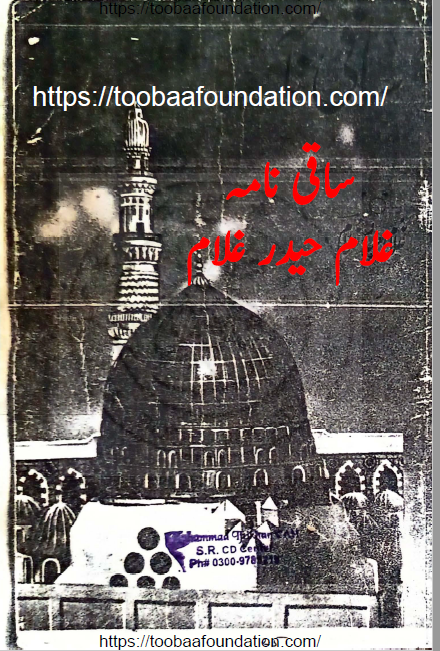


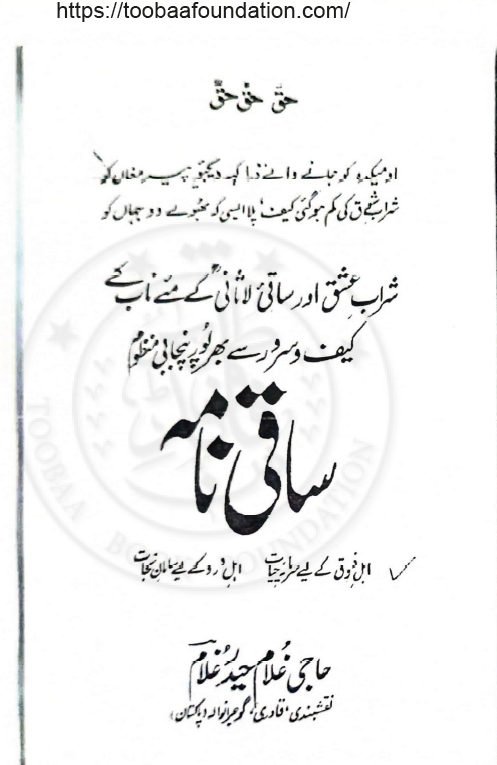
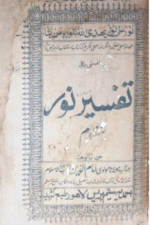
Saqi Nama/ساقی نامہ
Author : Toobaa Book Foundation
“Saaqi Nama” is a unique and spiritually enriching collection of Islamic spiritual poetry and Naatiya poetry book by Ghulam Haider Ghulam Naqshbandi Qadri Zaid Majdahu. This book delves into the depths of divine love poetry, devotion to the Prophet Muhammad (PBUH), and Sufi mysticism and devotion. Each verse beautifully reflects the harmony of nature and mystical poetry on Prophet Muhammad (PBUH), stirring emotions of spiritual longing within the reader.
The poetry in “Saaqi Nama” is imbued with the essence of Islamic Sufi poetry and mystical insight. The words resonate with the eternal quest for spiritual connection, inspiring the reader with a profound sense of Sufi wisdom and enlightenment.
Haji Ghulam Haider Sahib’s (Haji Ghulam Haider Sahib) heartfelt poetry mirrors the Sufi traditions of Punjab and the spiritual heritage of his esteemed predecessors, particularly his deep-rooted connection with Syed Jamaat Ali Shah Sani Alipuri (Syed Jamaat Ali Shah Sani Alipuri), a revered figure in the Naqshbandi Sufi order.
Alipur Saydan – A Hub of Spiritual Legacy
Alipur Saydan, located in Sialkot, Pakistan, is a historically significant and sacred town. It has been home to great spiritual figures such as Syed Hafiz Jamaat Ali Shah Sahib (Syed Hafiz Jamaat Ali Shah Sahib) and Syed Jamaat Ali Shah Sani (Syed Jamaat Ali Shah Sani), whose presence illuminated the region with the light of faith and divine blessings.
Chorah Sharif – The Spiritual Center
Chorah Sharif, in Gujranwala, holds a central place in the realm of Sufism and spiritual enlightenment. It has nurtured countless seekers of truth under the guidance of saints like Baba Ji Faqir Muhammad Chorahi (Baba Ji Faqir Muhammad Chorahi) and Hazrat Aman Sahib (Hazrat Aman Sahib), spreading divine wisdom far and wide.
“Saaqi Nama” – A Mirror of Love and Devotion
Each verse in “Saaqi Nama” radiates with the fervor of divine love and devotion to the Prophet Muhammad (PBUH). The poetry carries an eternal glow of Islamic heritage of Sialkot, touching the hearts of seekers on the path of spirituality.
Haji Ghulam Haider Sahib’s poetic contribution is a valuable addition to Sufi literature in Urdu. May Allah bless his passion and grant this work the power to guide seekers of truth for generations to come.
This book is available for free download and online reading at Toobaa Book Foundation. For more details and to get your free copy, visit the link below:
Customer Reviews
There are no reviews yet.
Related products
-

The Muwatta of Imam Muhammad (ENGLISH)
Imam Malik ibn Anas and Imam Muhammad ibn al-Hasan. This topic is of particular interest to students of hadith, as it relates to the transmission and narration of the Muwatta, a significant collection of hadith and legal rulings. Let’s break down the topic step by step:
- Imam Malik ibn Anas: Imam Malik (711-795 CE) was a prominent Islamic scholar and jurist who lived in Medina, one of the holiest cities in Islam. He is best known for compiling the “Muwatta,” which is a collection of hadith and legal rulings. Imam Malik’s deep knowledge of Islamic traditions, his reputation for integrity, and his proximity to the place where the Prophet Muhammad lived and taught gave his collection a special significance.
- The Muwatta: The “Muwatta” is a compilation of hadith and legal rulings organized by Imam Malik. It covers a wide range of topics related to Islamic law, ethics, social matters, and more. The Muwatta is highly regarded for its authenticity and is considered one of the earliest and most comprehensive collections of its kind.
- Imam Muhammad ibn al-Hasan: Imam Muhammad (also known as Muhammad al-Shaybani) was a distinguished student of Imam Abu Hanifa and a close companion of Imam Malik. He was also a scholar of Islamic jurisprudence and played a significant role in transmitting the teachings of his teachers.
- Narration of Imam Muhammad ibn al-Hasan: Imam Muhammad ibn al-Hasan narrated the Muwatta of Imam Malik. This means that he learned the hadith and legal rulings directly from Imam Malik and then transmitted them to others. Narrators like Imam Muhammad are crucial in preserving the authenticity of the hadith collection and ensuring that it is accurately transmitted from one generation to another.
In summary, the topic of “The Muwatta of Imam Malik ibn Anas in the narration of Imam Muhammad ibn al-Hasan” refers to the process of how Imam Muhammad ibn al-Hasan, a student of Imam Malik, learned and transmitted the Muwatta collection. This transmission helps maintain the accuracy and authenticity of the collection, making it a reliable source of guidance for students of hadith, scholars, and anyone seeking a deeper understanding of Islamic law and teachings.
The Muwatta of Imam Muhammad is an important and influential collection of hadith (sayings, actions, and approvals of the Prophet Muhammad) and legal rulings in Islamic jurisprudence (fiqh). It holds a significant place in Islamic scholarship and is highly regarded by scholars, jurists, and students of Islam.
Here are some key points that describe the importance of the Muwatta of Imam Muhammad:
- Authenticity: The Muwatta is considered one of the most authentic collections of hadith and legal traditions. Imam Muhammad ibn Hasan al-Shaybani, the author of the Muwatta, was a prominent disciple of Imam Abu Hanifa, one of the founders of the Hanafi school of Islamic jurisprudence. The hadith and legal rulings included in the Muwatta are meticulously selected for their authenticity, which adds to its credibility among scholars.
- Comprehensive Content: The Muwatta covers a wide range of topics, including rituals, ethics, social matters, family law, business transactions, and more. It provides a comprehensive overview of various aspects of Islamic life and jurisprudence, making it a valuable resource for understanding Islamic teachings and practices.
- Simplicity and Accessibility: One of the notable features of the Muwatta is its simplicity and straightforwardness. Imam Muhammad intentionally structured the collection in a way that makes it easy to understand and apply. This accessibility has contributed to its widespread use among scholars and students alike.
- Influence on Jurisprudence: The Muwatta played a crucial role in shaping the Hanafi school of jurisprudence and contributed to the development of Islamic legal thought in general. The hadith and legal opinions in the Muwatta served as foundational sources for deriving legal rulings and principles within the Hanafi tradition.
- Cross-Tradition Appeal: While Imam Muhammad was a follower of the Hanafi school, his Muwatta gained recognition beyond the Hanafi tradition. Scholars from other Islamic jurisprudential schools also appreciate the collection for its valuable insights into early Islamic legal and social practices.
- Historical Insight: The Muwatta provides a glimpse into the social, cultural, and legal dynamics of early Islamic society. It offers historical context for various legal rulings and practices, contributing to a better understanding of the development of Islamic law and the challenges faced by the Muslim community during that era.
- Preservation of Tradition: The Muwatta is an example of the efforts made by early Islamic scholars to preserve and transmit the teachings of the Prophet Muhammad and his companions accurately. It serves as a bridge connecting later generations with the practices and wisdom of the earliest Muslims.
In summary, the Muwatta of Imam Muhammad holds immense importance due to its authenticity, comprehensive content, influence on jurisprudence, accessibility, cross-tradition appeal, historical insights, and role in preserving Islamic tradition. It continues to be studied and referenced by scholars and students of Islam worldwide as a valuable source of guidance and knowledge.
Imam Muhammad ibn Hasan al-Shaybani, known as one of the “Two Companions,” is one of the distinguished disciples of Imam Abu Hanifa. Among his two prominent disciples, the other is Imam Abu Yusuf. Imam Muhammad’s works encompass all aspects of jurisprudence and law, and they are highly comprehensive. His significant contributions have greatly influenced later Hanafi scholars.
Within the Hanafi school of thought, Imam Muhammad al-Shaybani holds a central position. He is considered a key figure in Sunni jurisprudential tradition and a bridge between different schools of thought. Among his contemporaries, his esteemed scholars include both Imam Abu Hanifa and Imam Malik. Notably, Imam Shafi’i is also counted among his students, and Imam Ahmad ibn Hanbal, a student of Imam Shafi’i, further connects him to the third major school of thought. Thus, Imam Muhammad al-Shaybani’s teachings are intertwined with the founders of all four major jurisprudential schools, showcasing his profound influence.
-

تحریک پاکستان میں خطہ پوٹھوہار کا کردار | Tahreek-e-Pakistan mein Khitta Pothohar ka Kirdar
The book “Tehreek-e-Pakistan mein Khittah-e-Pothohar ka Kirdar” (The Role of Pothohar Region in the Pakistan Movement) is a sincere and research-based effort by Safdar Shahid, compiled with dedication and devotion. The work was initiated in March 1992 and, after a full year of continuous research, struggle, and effort, it was completed and published on the historic occasion of Pakistan’s Golden Jubilee celebrations.
Despite the challenges of official duties and family responsibilities, the author sacrificed his personal comfort and tirelessly traveled across the length and breadth of the Pothohar region—village to village, town to town, and valley to valley—in search of historical accounts and testimonies. His aim was to bring forth the struggles, sacrifices, and leadership of the people of Pothohar, who played a remarkable and unforgettable role in the Pakistan Movement.
This book serves as a beacon of guidance for the younger generation by paying tribute to the unsung heroes, workers, and leaders of Pothohar, whose devotion to the cause of Pakistan remains exemplary. Though the author humbly acknowledges the limitations of his individual effort, the book reflects a deep passion for research and national service, making it an invaluable contribution to the history of Pakistan’s independence movement.
The author presents this work with utmost humility and sincerity to the readers of intellect and vision, hoping they will enrich it with their constructive feedback and thoughtful suggestions, thereby further enhancing its value and impact.
-
The Muwatta of Imam Muhammad (ENGLISH)
Imam Malik ibn Anas and Imam Muhammad ibn al-Hasan. This topic is of particular interest to students of hadith, as it relates to the transmission and narration of the Muwatta, a significant collection of hadith and legal rulings. Let’s break down the topic step by step:
- Imam Malik ibn Anas: Imam Malik (711-795 CE) was a prominent Islamic scholar and jurist who lived in Medina, one of the holiest cities in Islam. He is best known for compiling the “Muwatta,” which is a collection of hadith and legal rulings. Imam Malik’s deep knowledge of Islamic traditions, his reputation for integrity, and his proximity to the place where the Prophet Muhammad lived and taught gave his collection a special significance.
- The Muwatta: The “Muwatta” is a compilation of hadith and legal rulings organized by Imam Malik. It covers a wide range of topics related to Islamic law, ethics, social matters, and more. The Muwatta is highly regarded for its authenticity and is considered one of the earliest and most comprehensive collections of its kind.
- Imam Muhammad ibn al-Hasan: Imam Muhammad (also known as Muhammad al-Shaybani) was a distinguished student of Imam Abu Hanifa and a close companion of Imam Malik. He was also a scholar of Islamic jurisprudence and played a significant role in transmitting the teachings of his teachers.
- Narration of Imam Muhammad ibn al-Hasan: Imam Muhammad ibn al-Hasan narrated the Muwatta of Imam Malik. This means that he learned the hadith and legal rulings directly from Imam Malik and then transmitted them to others. Narrators like Imam Muhammad are crucial in preserving the authenticity of the hadith collection and ensuring that it is accurately transmitted from one generation to another.
In summary, the topic of “The Muwatta of Imam Malik ibn Anas in the narration of Imam Muhammad ibn al-Hasan” refers to the process of how Imam Muhammad ibn al-Hasan, a student of Imam Malik, learned and transmitted the Muwatta collection. This transmission helps maintain the accuracy and authenticity of the collection, making it a reliable source of guidance for students of hadith, scholars, and anyone seeking a deeper understanding of Islamic law and teachings.
The Muwatta of Imam Muhammad is an important and influential collection of hadith (sayings, actions, and approvals of the Prophet Muhammad) and legal rulings in Islamic jurisprudence (fiqh). It holds a significant place in Islamic scholarship and is highly regarded by scholars, jurists, and students of Islam.
Here are some key points that describe the importance of the Muwatta of Imam Muhammad:
- Authenticity: The Muwatta is considered one of the most authentic collections of hadith and legal traditions. Imam Muhammad ibn Hasan al-Shaybani, the author of the Muwatta, was a prominent disciple of Imam Abu Hanifa, one of the founders of the Hanafi school of Islamic jurisprudence. The hadith and legal rulings included in the Muwatta are meticulously selected for their authenticity, which adds to its credibility among scholars.
- Comprehensive Content: The Muwatta covers a wide range of topics, including rituals, ethics, social matters, family law, business transactions, and more. It provides a comprehensive overview of various aspects of Islamic life and jurisprudence, making it a valuable resource for understanding Islamic teachings and practices.
- Simplicity and Accessibility: One of the notable features of the Muwatta is its simplicity and straightforwardness. Imam Muhammad intentionally structured the collection in a way that makes it easy to understand and apply. This accessibility has contributed to its widespread use among scholars and students alike.
- Influence on Jurisprudence: The Muwatta played a crucial role in shaping the Hanafi school of jurisprudence and contributed to the development of Islamic legal thought in general. The hadith and legal opinions in the Muwatta served as foundational sources for deriving legal rulings and principles within the Hanafi tradition.
- Cross-Tradition Appeal: While Imam Muhammad was a follower of the Hanafi school, his Muwatta gained recognition beyond the Hanafi tradition. Scholars from other Islamic jurisprudential schools also appreciate the collection for its valuable insights into early Islamic legal and social practices.
- Historical Insight: The Muwatta provides a glimpse into the social, cultural, and legal dynamics of early Islamic society. It offers historical context for various legal rulings and practices, contributing to a better understanding of the development of Islamic law and the challenges faced by the Muslim community during that era.
- Preservation of Tradition: The Muwatta is an example of the efforts made by early Islamic scholars to preserve and transmit the teachings of the Prophet Muhammad and his companions accurately. It serves as a bridge connecting later generations with the practices and wisdom of the earliest Muslims.
In summary, the Muwatta of Imam Muhammad holds immense importance due to its authenticity, comprehensive content, influence on jurisprudence, accessibility, cross-tradition appeal, historical insights, and role in preserving Islamic tradition. It continues to be studied and referenced by scholars and students of Islam worldwide as a valuable source of guidance and knowledge.
Imam Muhammad ibn Hasan al-Shaybani, known as one of the “Two Companions,” is one of the distinguished disciples of Imam Abu Hanifa. Among his two prominent disciples, the other is Imam Abu Yusuf. Imam Muhammad’s works encompass all aspects of jurisprudence and law, and they are highly comprehensive. His significant contributions have greatly influenced later Hanafi scholars.
Within the Hanafi school of thought, Imam Muhammad al-Shaybani holds a central position. He is considered a key figure in Sunni jurisprudential tradition and a bridge between different schools of thought. Among his contemporaries, his esteemed scholars include both Imam Abu Hanifa and Imam Malik. Notably, Imam Shafi’i is also counted among his students, and Imam Ahmad ibn Hanbal, a student of Imam Shafi’i, further connects him to the third major school of thought. Thus, Imam Muhammad al-Shaybani’s teachings are intertwined with the founders of all four major jurisprudential schools, showcasing his profound influence.
-

Ahad-e-Nabvi Ka Taleemi Nizam | عہد نبوی کا تعلیمی نظام
Ahad-e-Nabvi Ka Taleemi Nizam | عہد نبوی کا تعلیمی نظام محمد یاسین شیخ کی ایک اہم اسلامی و تحقیقی کتاب ہے جس میں رسول اکرم ﷺ کے دور کے تعلیمی نظام، تدریسی اصول، تربیتی طریقوں اور اسلامی معاشرے کی علمی بنیادوں کو تفصیل سے بیان کیا گیا ہے۔
یہ کتاب اسلامی تعلیم، سیرت النبی ﷺ، دینی تربیت، مدارس کے نظام اور اسلامی معاشرتی اصلاح کے موضوعات پر گہری معلومات فراہم کرتی ہے۔ مصنف نے عہد نبوی ﷺ کے تعلیمی ماحول، صحابہ کرامؓ کی علمی تربیت، مسجد نبوی کے کردار اور قرآن و سنت کی روشنی میں تعلیم کے اصولوں کو مؤثر انداز میں پیش کیا ہے۔
یہ کتاب اسلامیات، سیرت، دینی تعلیم اور اسلامی تاریخ سے دلچسپی رکھنے والے قارئین، طلبہ اور محققین کے لیے نہایت مفید ہے۔
-
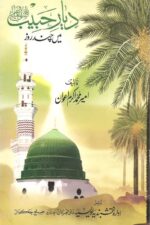
Diyar-e-Habib Mein Chand Roz | دیارِ حبیب میں چند روز
دیارِ حبیب میں چند روز حضرت امیر محمد اکرم اعوانؒ کی ایک روح پرور سفری و روحانی تصنیف ہے، جس میں حرمین شریفین، حج و عمرہ کے مشاہدات، عشقِ رسول ﷺ، روحانی کیفیات اور اسلامی مقدسات سے وابستہ احساسات کو نہایت دلنشین انداز میں بیان کیا گیا ہے۔ مصنف نے اپنے سفر کے دوران پیش آنے والے واقعات، عبادات کے اثرات اور مدینہ منورہ و مکہ مکرمہ کی روحانی فضا کا تذکرہ کیا ہے، جو قاری کے دل میں عقیدت و محبت کے جذبات پیدا کرتا ہے۔
یہ کتاب محض ایک سفرنامہ نہیں بلکہ روحانی تربیت، عشقِ نبوی ﷺ اور اصلاحِ باطن کا پیغام بھی اپنے اندر سموئے ہوئے ہے۔ حضرت امیر محمد اکرم اعوانؒ سلسلۂ نقشبندیہ اویسیہ کے معروف شیخ، مفسر اور روحانی راہنما تھے، جن کی تصانیف اور دروس نے ہزاروں افراد کی فکری و روحانی تربیت میں کردار ادا کیا۔
حج، عمرہ، اسلامی سفرناموں، روحانی ادب اور سیرتِ نبوی ﷺ سے دلچسپی رکھنے والے قارئین کے لیے یہ کتاب نہایت مفید اور ایمان افروز مطالعہ ہے۔
-

Nuqoosh-e-Seerat
“Nuqoosh-e-Seerat” is a collection of essays and articles that delve into various aspects of the Prophet’s life, character, teachings, and his impact on society. It is highly regarded for its insightful analysis, historical accuracy, and ability to convey the profound lessons and inspiration derived from the life of Prophet Muhammad (S.A.W).
The book covers a wide range of topics related to the Prophet’s life, including his birth, upbringing, interactions with his companions, battles, spiritual experiences, and his role as a leader and reformer. It is often considered a valuable resource for those seeking to deepen their understanding of the Seerah and draw lessons from the Prophet’s actions and teachings.
If you have the opportunity to read “Nuqoosh-e-Seerat” by Hakeem Muhammad Saeed, you will likely find it to be a rich source of knowledge and inspiration about the life of the Holy Prophet Muhammad (S.A.W).
-

TOOBAA RESEARCH BLOG ENGLISH BOOKS
☆THE NOBLE QURAN
(ENGLISH TRANSLATION)
☆URDU TRANSLATION OF QURAN
KNOWN AS : MOUZUH E FURQAN
BY: HAZRAT SHEIKH UL HIND
ALLAMA MAHMOOD HASSAN DEOBANDI
☆URDU TAFSEER (COMMANTERY)
KNOWN AS: TAFSEER E USMANI
BY: SHEIKH UL ISLAM ALLAMA SHABBIR AHMED USMANI
☆ENGLISH TRANSLATION BY:
MUHAMMAD ASHFAQ AHMED
Presented By : TOOBAA RESEARCH LIBRARY
……………………..
The Abridged Shamail e Tirmizi
Author: Muḥammad ibn Īsá Tirmidhī
With Notes from Sheikh ul Hadeez Moulana Mohamad Zakariya
And Mufti Ahmed E. Bemat
Translated by: Murtaz Hussain F. Quraishi
Presented By : TOOBAA RESEARCH LIBRARY
………………………………..
THE GREATEST BENEFACTOR OF MANKIND OF HUMAN RIGHTS
☆Muhsin e Insaniyat S.A.W aur Insani Haqooq
Khutbaa Hajaa tul Widaa se istshhad(URDU)
WRITTEN BY: DR Hafiz MUHAMMAD SANI (THANI)
preface : Dr Allama Muhadizz Abdul Haleem Chishti sb
Translated by: ZAHARA BAINTNER
GERMAN NAME: SABINE BAINTNER
Presented by: TOOBAA RESEARCH LIBRARY
………………………….
BY : KAUSAR NIAZI
PRESENTED BY : TOOBAA RESEARCH LIBRARY
………………………….
(SIRAT- US – SIDDIQ)
THE FIRST CALIPH OF ISLAM
BY: Nawab Sadr Yar Jung Bahadur
Maulvi Muhammad Habibur Rahman Khan Sharwani
Translated by: SYED MOINUL HAQ
RESENTED BY: TOOBAA RESEARCH LIBRARY
………………………..
(THE SECOND CALIPH OF ISLAM)
AL FAROOQ – VOL 2
AUTHOR: ALLAMA SHIBI NOUMANI
TRANSLATED BY: MUHAMMAD SALEEM
PRESENTED BY: TOOBAA RESEARCH LIBRARY
………………………..
IMAM ABU HANIFAH LIFE AND WORK
(SEERAT U NOUMAN)
AUTHOR: ALLAMA SHIBLI NOUMANI
TRANSLATED BY: M. HADI HUSSAIN
PRESENTED BY: TOOBAA RESEARCH LIBRARY
……………………
THE POLITICAL THOUGHT OF IBN TAYMIYAH
BY : PROF QAMARUDDIN KHAN
PRESENTED BY : TOOBAA RESEARCH LIBRARY
…………………………………..
(TAWEEL UL AHADEEZ)
BY: SHAH WALIULLAH
RENDERED INTO ENGLISH
BY: PROF G. N. JALBANI
PRESENTED BY : TOOBAA RESEARCH LIBRARY
…………………………
BY: IMAM SHAH WALIULLAH DEHLVI
RENDERED INTO ENGLISH
BY: PROF G. N. JALBANI
PRESENTED BY : TOOBAA RESEARCH BLOG
…………………………………………
A SAINT-SCHOLAR OF MUSLIM INDIA
AUTHOR: A. D. MUZTAR
Presented by: TOOBAA RESEACRH LIBRARY
…………………………….
Author: DR. A. J. HALEPOTA
(Professor of comparative religion and Islamic culture, University of Sind. & Ex. Chairman Council of Islamic ideology Pakistan )
Presented by: TOOBAA RESEACRH LIBRARY
……………….
RESEARCH PAPER FOR: PhD
RESEARCH by: TASADDUQ HUSAIN
ALIGARH MUSLIM UNIVERSTY INDIA
REPRESENTED BY: TOOBAA RESEARCH LIBRARY
…………………..
ENGLISH TRANSLATION
BY : C. R. TYSER, B. A. L. + D. G. DEMETRIADES, +
ISMAIL HAQQI EFFENDI
FOREWARD BY : JUSTICE S. A. REHMAN
PRESENTED BY : TOOBAA RESEARCH LIBRARY
………………………….
BY : MAULANA TAQI AMINI
PRESENTED BY : TOOBAA RESEARCH LIBRARY
…………………
Be the first to review “Saqi Nama/ساقی نامہ”