-

Al Juhd ul Miql fi Tanzee Al Muoiz wal Muzzil Vol : 1
Al Juhd ul Miql fi Tanzee Al Muoiz wal Muzzil
Vol : 1
By : allama mahmood Hassan deobandi
(sheikh ul hind )
الجہدُ المِقل فی تنزیہ المعُز و المُزِل
جلد : اول
تالیف : علامہ محمود حسن دیوبندیؒ
(حضرت شیخ الہند)
-

Al Juhd ul Miql fi Tanzee Al Muoiz wal Muzzil Vol : 2
Al Juhd ul Miql fi Tanzee Al Muoiz wal Muzzil
Vol : 2
By : allama mahmood Hassan deobandi
(Hazrat Sheikh ul Hind )
الجہدُ المِقل فی تنزیہ المعُز و المُزِل
جلد : دوم
تالیف : علامہ محمود حسن دیوبندیؒ
(حضرت شیخ الہند)
-

AL MAHDI AND END OF THE TIME
AL MAHDI
AND END OF THE TIME
WRITTEN BY :
MUHAMMAD IBN IZZAT
MUHAMMAD ARIF
-

AL-ARBAEEN (40 HADITHS) BY: MAULANA ISHAAQ SAHIB
الاربعین
(مجموعہ احادیث)
از: مولانا محمد اسحٰق صاحب
AL-ARBAEEN
(40 HADITHS)
BY: MAULANA ISHAAQ SAHIB
……………………………………………………………………………………….
مختارات حکیم من کلام سید المرسلینﷺ
اربعین احادیث مع شرح
مئولفہ : مولانا حکیم عبدالقدوس مہاجر مدنیؒ
۔۔۔۔۔۔۔۔۔۔۔۔۔۔۔۔۔۔۔۔۔
اربعین من احادیث سید المرسلینﷺ
مرتبہ : شمس العلماء مولوی سید ممتاز علی
پیشکش : طوبیٰ ریسرچ لائبریری
۔۔۔۔۔۔۔۔۔۔۔۔۔۔۔۔۔۔
مع عربی متن و شرح اردو
اربعین عربی : امام ابو زکریا محی الدین النوویؒ
مترجم و شارح اردو : مفتی محمد عاشق الہی المدنی ؒ
۔۔۔۔۔۔۔۔۔۔۔۔۔۔۔۔۔
امام شاہ ولی اللہ محدث دہلویؒ
بروایت : حضرت علی کرم اللہ وجہہ
ترجمہ : علامہ ڈاکٹر عبدالحلیم چشتی ؒ
تہذیبِ جدید تشریح : مولانا عبدالماجد دریابادی ؒ
۔۔۔۔۔۔۔۔۔۔۔۔۔۔۔۔۔۔۔۔۔۔۔۔۔۔۔
تالیف : فضیلۃ الشیخ عبداللہ دانشؒ
ترتیب و تخریج : میاں طاہر
پیشکش : طوبیٰ ریسرچ لائبریری
۔۔۔۔۔۔۔۔۔۔۔۔۔۔
-
-

Al-Qaul al-Jali Fi Hayat-un-Nabi | القول الجلی فی حیات النبی
القول الجلی فی حیات النبی ایک مستند اور عقیدت آمیز سیرتی تصنیف ہے جس میں حضور نبی اکرم ﷺ کی حیاتِ طیبہ کے مختلف پہلوؤں کو نہایت سادہ، مدلل اور مؤثر انداز میں بیان کیا گیا ہے۔ حضرت مولانا قاضی شمس الدین نے اس کتاب میں سیرتِ رسول ﷺ کو قرآن و سنت کی روشنی میں پیش کیا ہے، جو عام قارئین کے ساتھ ساتھ طلبۂ علومِ دینیہ کے لیے بھی مفید ہے۔
-

Alfaz Ka Tilism | الفاظ کا طلسم
Alfaz Ka Tilism | الفاظ کا طلسم اردو زبان، الفاظ کی تاریخ، ان کے معنوی ارتقاء اور لسانی پس منظر پر ایک منفرد اور اہم تحقیقی تصنیف ہے۔ اس کتاب کے مصنف ڈاکٹر خالد حسن قادری ہیں، جبکہ اسے معروف ماہرِ لسانیات اور لغت نگار ڈاکٹر رؤف پاریکھ نے مرتب و مدون کیا۔ کتاب 2022 میں شائع ہوئی اور اردو زبان و ادب کے حلقوں میں خاص توجہ حاصل کی۔
اس کتاب میں اردو، عربی، فارسی اور دیگر زبانوں سے اردو میں آنے والے الفاظ کی اصل، ان کے استعمال، تاریخی سفر اور معنوی تبدیلیوں پر روشنی ڈالی گئی ہے۔ مصنف نے الفاظ کی دنیا کو نہایت دلچسپ، تحقیقی اور ادبی انداز میں پیش کیا ہے، جس سے قاری زبان کی تہذیبی اور ثقافتی تاریخ سے بھی آگاہ ہوتا ہے۔
ڈاکٹر رؤف پاریکھ، جو اردو کے ممتاز لغت نگار اور ماہرِ لسانیات ہیں، نے اس مسودے کو مرتب کرکے شائع کروایا۔ ان کے مطابق کتاب کا مسودہ محفوظ تھا جسے بعد ازاں الفاظ کا طلسم کے عنوان سے مرتب کرکے شائع کیا گیا۔
یہ کتاب اردو زبان، لسانیات، علمِ اشتقاق، لغت نویسی، ادبیات اور زبان کی تاریخ میں دلچسپی رکھنے والے طلبہ، اساتذہ، محققین اور عام قارئین کے لیے نہایت مفید ہے۔
-
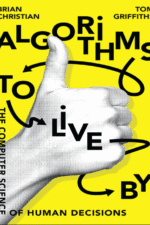
Algorithms to Live By The Computer Science of Human Decisions PDF
Imagine you’re searching for an apartment in San Francisco—arguably the
most harrowing American city in which to do so. The booming tech sector
and tight zoning laws limiting new construction have conspired to make the
city just as expensive as New York, and by many accounts more
competitive. New listings go up and come down within minutes, open
houses are mobbed, and often the keys end up in the hands of whoever can
physically foist a deposit check on the landlord first.
Such a savage market leaves little room for the kind of fact-finding and
deliberation that is theoretically supposed to characterize the doings of the
rational consumer. Unlike, say, a mall patron or an online shopper, who can
compare options before making a decision, the would-be San Franciscan
has to decide instantly either way: you can take the apartment you are
currently looking at, forsaking all others, or you can walk away, never to
return.
Let’s assume for a moment, for the sake of simplicity, that you care only
about maximizing your chance of getting the very best apartment available.
Your goal is reducing the twin, Scylla-and-Charybdis regrets of the “one
that got away” and the “stone left unturned” to the absolute minimum. You
run into a dilemma right off the bat: How are you to know that an apartment
is indeed the best unless you have a baseline to judge it by? And how are
you to establish that baseline unless you look at (and lose) a number of
apartments? The more information you gather, the better you’ll know the
right opportunity when you see it—but the more likely you are to have
already passed it by.
So what do you do? How do you make an informed decision when the
very act of informing it jeopardizes the outcome? It’s a cruel situation,
bordering on paradox.
When presented with this kind of problem, most people will intuitively
say something to the effect that it requires some sort of balance between
looking and leaping—that you must look at enough apartments to establish
a standard, then take whatever satisfies the standard you’ve established.
This notion of balance is, in fact, precisely correct. What most people don’t
say with any certainty is what that balance is. Fortunately, there’s an
answer.
Thirty-seven percent.
If you want the best odds of getting the best apartment, spend 37% of
your apartment hunt (eleven days, if you’ve given yourself a month for the
search) noncommittally exploring options. Leave the checkbook at home;
you’re just calibrating. But after that point, be prepared to immediately
commit—deposit and all—to the very first place you see that beats
whatever you’ve already seen. This is not merely an intuitively satisfying
compromise between looking and leaping. It is the provably optimal
solution.
We know this because finding an apartment belongs to a class of
mathematical problems known as “optimal stopping” problems. The 37%
rule defines a simple series of steps—what computer scientists call an
“algorithm”—for solving these problems. And as it turns out, apartment
hunting is just one of the ways that optimal stopping rears its head in daily
life. Committing to or forgoing a succession of options is a structure that
appears in life again and again, in slightly different incarnations. How many
times to circle the block before pulling into a parking space? How far to
push your luck with a risky business venture before cashing out? How long
to hold out for a better offer on that house or car?
The same challenge also appears in an even more fraught setting: dating.
Optimal stopping is the science of serial monogamy.
Simple algorithms offer solutions not only to an apartment hunt but to
all such situations in life where we confront the question of optimal
stopping. People grapple with these issues every day—although surely
poets have spilled more ink on the tribulations of courtship than of parking
—and they do so with, in some cases, considerable anguish. But the anguish
is unnecessary. Mathematically, at least, these are solved problems.
Every harried renter, driver, and suitor you see around you as you go
through a typical week is essentially reinventing the wheel. They don’t need
a therapist; they need an algorithm. The therapist tells them to find the right,
comfortable balance between impulsivity and overthinking.
The algorithm tells them the balance is thirty-seven percent.
* * *
There is a particular set of problems that all people face, problems that are a
direct result of the fact that our lives are carried out in finite space and time.
What should we do, and leave undone, in a day or in a decade? What degree
of mess should we embrace—and how much order is excessive? What
balance between new experiences and favored ones makes for the most
fulfilling life?
These might seem like problems unique to humans; they’re not. For
more than half a century, computer scientists have been grappling with, and
in many cases solving, the equivalents of these everyday dilemmas. How
should a processor allocate its “attention” to perform all that the user asks
of it, with the minimum overhead and in the least amount of time? When
should it switch between different tasks, and how many tasks should it take
on in the first place? What is the best way for it to use its limited memory
resources? Should it collect more data, or take an action based on the data it
already has? Seizing the day might be a challenge for humans, but
computers all around us are seizing milliseconds with ease. And there’s
much we can learn from how they do it.
Talking about algorithms for human lives might seem like an odd
juxtaposition. For many people, the word “algorithm” evokes the arcane
and inscrutable machinations of big data, big government, and big business:
increasingly part of the infrastructure of the modern world, but hardly a
source of practical wisdom or guidance for human affairs. But an algorithm
is just a finite sequence of steps used to solve a problem, and algorithms are
much broader—and older by far—than the computer. Long before
algorithms were ever used by machines, they were used by people.
The word “algorithm” comes from the name of Persian mathematician
al-Khwārizmī, author of a ninth-century book of techniques for doing
mathematics by hand. (His book was called al-Jabr wa’l-Muqābala—and
the “al-jabr” of the title in turn provides the source of our word “algebra.”)
The earliest known mathematical algorithms, however, predate even alKhwārizmī’s work: a four-thousand-year-old Sumerian clay tablet found
near Baghdad describes a scheme for long division.
But algorithms are not confined to mathematics alone. When you cook
bread from a recipe, you’re following an algorithm. When you knit a
sweater from a pattern, you’re following an algorithm. When you put a
sharp edge on a piece of flint by executing a precise sequence of strikes
with the end of an antler—a key step in making fine stone tools—you’re
following an algorithm. Algorithms have been a part of human technology
ever since the Stone Age.
* * *
In this book, we explore the idea of human algorithm design—searching for
better solutions to the challenges people encounter every day. Applying the
lens of computer science to everyday life has consequences at many scales.
Most immediately, it offers us practical, concrete suggestions for how to
solve specific problems. Optimal stopping tells us when to look and when
to leap. The explore/exploit tradeoff tells us how to find the balance
between trying new things and enjoying our favorites. Sorting theory tells
us how (and whether) to arrange our offices. Caching theory tells us how to
fill our closets. Scheduling theory tells us how to fill our time.
At the next level, computer science gives us a vocabulary for
understanding the deeper principles at play in each of these domains. As
Carl Sagan put it, “Science is a way of thinking much more than it is a body
of knowledge.” Even in cases where life is too messy for us to expect a
strict numerical analysis or a ready answer, using intuitions and concepts
honed on the simpler forms of these problems offers us a way to understand
the key issues and make progress.
Most broadly, looking through the lens of computer science can teach us
about the nature of the human mind, the meaning of rationality, and the
oldest question of all: how to live. Examining cognition as a means of
solving the fundamentally computational problems posed by our
environment can utterly change the way we think about human rationality.
The notion that studying the inner workings of computers might reveal
how to think and decide, what to believe and how to behave, might strike
many people as not only wildly reductive, but in fact misguided. Even if
computer science did have things to say about how to think and how to act,
would we want to listen? We look at the AIs and robots of science fiction,
and it seems like theirs is not a life any of us would want to live.
In part, that’s because when we think about computers, we think about
coldly mechanical, deterministic systems: machines applying rigid
deductive logic, making decisions by exhaustively enumerating the options,
and grinding out the exact right answer no matter how long and hard they
have to think. Indeed, the person who first imagined computers had
something essentially like this in mind. Alan Turing defined the very notion
of computation by an analogy to a human mathematician who carefully
works through the steps of a lengthy calculation, yielding an unmistakably
right answer.
So it might come as a surprise that this is not what modern computers
are actually doing when they face a difficult problem. Straightforward
arithmetic, of course, isn’t particularly challenging for a modern computer.
Rather, it’s tasks like conversing with people, fixing a corrupted file, or
winning a game of Go—problems where the rules aren’t clear, some of the
required information is missing, or finding exactly the right answer would
require considering an astronomical number of possibilities—that now pose
the biggest challenges in computer science. And the algorithms that
researchers have developed to solve the hardest classes of problems have
moved computers away from an extreme reliance on exhaustive calculation.
Instead, tackling real-world tasks requires being comfortable with chance,
trading off time with accuracy, and using approximations.
As computers become better tuned to real-world problems, they provide
not only algorithms that people can borrow for their own lives, but a better
standard against which to compare human cognition itself. Over the past
decade or two, behavioral economics has told a very particular story about
human beings: that we are irrational and error-prone, owing in large part to
the buggy, idiosyncratic hardware of the brain. This self-deprecating story
has become increasingly familiar, but certain questions remain vexing. Why
are four-year-olds, for instance, still better than million-dollar
supercomputers at a host of cognitive tasks, including vision, language, and
causal reasoning?
The solutions to everyday problems that come from computer science
tell a different story about the human mind. Life is full of problems that are,
quite simply, hard. And the mistakes made by people often say more about
the intrinsic difficulties of the problem than about the fallibility of human
brains. Thinking algorithmically about the world, learning about the
fundamental structures of the problems we face and about the properties of
their solutions, can help us see how good we actually are, and better
understand the errors that we make.
In fact, human beings turn out to consistently confront some of the
hardest cases of the problems studied by computer scientists. Often, people
need to make decisions while dealing with uncertainty, time constraints,
partial information, and a rapidly changing world. In some of those cases,
even cutting-edge computer science has not yet come up with efficient,
always-right algorithms. For certain situations it appears that such
algorithms might not exist at all.
Even where perfect algorithms haven’t been found, however, the battle
between generations of computer scientists and the most intractable real-
world problems has yielded a series of insights. These hard-won precepts
are at odds with our intuitions about rationality, and they don’t sound
anything like the narrow prescriptions of a mathematician trying to force
the world into clean, formal lines. They say: Don’t always consider all your
options. Don’t necessarily go for the outcome that seems best every time.
Make a mess on occasion. Travel light. Let things wait. Trust your instincts
and don’t think too long. Relax. Toss a coin. Forgive, but don’t forget. To
thine own self be true.
Living by the wisdom of computer science doesn’t sound so bad after
all. And unlike most advice, it’s backed up by proofs.
* * *
Just as designing algorithms for computers was originally a subject that fell
into the cracks between disciplines—an odd hybrid of mathematics and
engineering—so, too, designing algorithms for humans is a topic that
doesn’t have a natural disciplinary home. Today, algorithm design draws
not only on computer science, math, and engineering but on kindred fields
like statistics and operations research. And as we consider how algorithms
designed for machines might relate to human minds, we also need to look to
cognitive science, psychology, economics, and beyond.
We, your authors, are familiar with this interdisciplinary territory. Brian
studied computer science and philosophy before going on to graduate work
in English and a career at the intersection of the three. Tom studied
psychology and statistics before becoming a professor at UC Berkeley,
where he spends most of his time thinking about the relationship between
human cognition and computation. But nobody can be an expert in all of the
fields that are relevant to designing better algorithms for humans. So as part
of our quest for algorithms to live by, we talked to the people who came up
with some of the most famous algorithms of the last fifty years. And we
asked them, some of the smartest people in the world, how their research
influenced the way they approached their own lives—from finding their
spouses to sorting their socks.
The next pages begin our journey through some of the biggest
challenges faced by computers and human minds alike: how to manage
finite space, finite time, limited attention, unknown unknowns, incomplete
information, and an unforeseeable future; how to do so with grace and
confidence; and how to do so in a community with others who are all
simultaneously trying to do the same. We will learn about the fundamental
mathematical structure of these challenges and about how computers are
engineered—sometimes counter to what we imagine—to make the most of
them. And we will learn about how the mind works, about its distinct but
deeply related ways of tackling the same set of issues and coping with the
same constraints. Ultimately, what we can gain is not only a set of concrete
takeaways for the problems around us, not only a new way to see the
elegant structures behind even the hairiest human dilemmas, not only a
recognition of the travails of humans and computers as deeply conjoined,
but something even more profound: a new vocabulary for the world around
us, and a chance to learn something truly new about ourselves. -

Allah Ki Madad Kyun Nahi Rahi? | اللہ کی مدد کیوں نہیں آ رہی؟
دو: “اللہ کی مدد کیوں نہیں آ رہی؟” ڈاکٹر گوہر مشتاق کی لکھی ہوئی ایک انتہائی فکری اور اصلاحی کتاب ہے۔ اس کتاب میں اس اہم اور دردناک سوال کا جائزہ لیا گیا ہے کہ عصرِ حاضر میں امتِ مسلمہ کو کیوں آزمائشوں، مشکلات اور غیبی نصرت سے محرومی کا سامنا ہے۔ مصنف نے قرآنی آیات، احادیثِ مبارکہ اور تاریخی تناظر کی روشنی میں ہماری اجتماعی کوتاہیوں، دینی و اخلاقی کمزوریوں اور اسلامی تعلیمات سے دوری کا محاسبہ کیا ہے، اور اسلاف کے نقشِ قدم پر چلتے ہوئے دوبارہ عروج حاصل کرنے کے لیے عملی لائحہ عمل پیش کیا ہے۔ فکری بیداری اور اصلاحِ احوال کے خواہاں قارئین کے لیے یہ ایک انتہائی مفید کتاب ہے۔
-

Allama Iqbal ke Chand Nadir o Nayaab Khutoot | علامہ اقبال کے چند نادر و نایاب خطوط
علامہ اقبال کے چند نادر و نایاب خطوط” ڈاکٹر ندیم شفیق کی ایک اہم تحقیقی تصنیف ہے جس میں علامہ محمد اقبال کے ایسے خطوط شامل کیے گئے ہیں جو عام طور پر دستیاب نہیں تھے۔ یہ خطوط اقبال کے فکری، ادبی اور شخصی پہلوؤں کو سمجھنے میں نہایت مددگار ہیں اور اقبال شناسی کے میدان میں ایک قیمتی اضافہ ہیں۔
-

Allama Iqbal Quiz | علامہ اقبال کوئز
علامہ اقبال کوئز” احسان دانش کی ایک تعلیمی اور معلوماتی کتاب ہے جس میں علامہ محمد اقبال کی زندگی، شاعری، فلسفہ اور افکار کو سوال و جواب (Quiz) کی صورت میں پیش کیا گیا ہے۔ یہ کتاب طلبہ، اساتذہ اور اقبال شناسی سے دلچسپی رکھنے والوں کے لیے نہایت مفید ہے۔
-
-